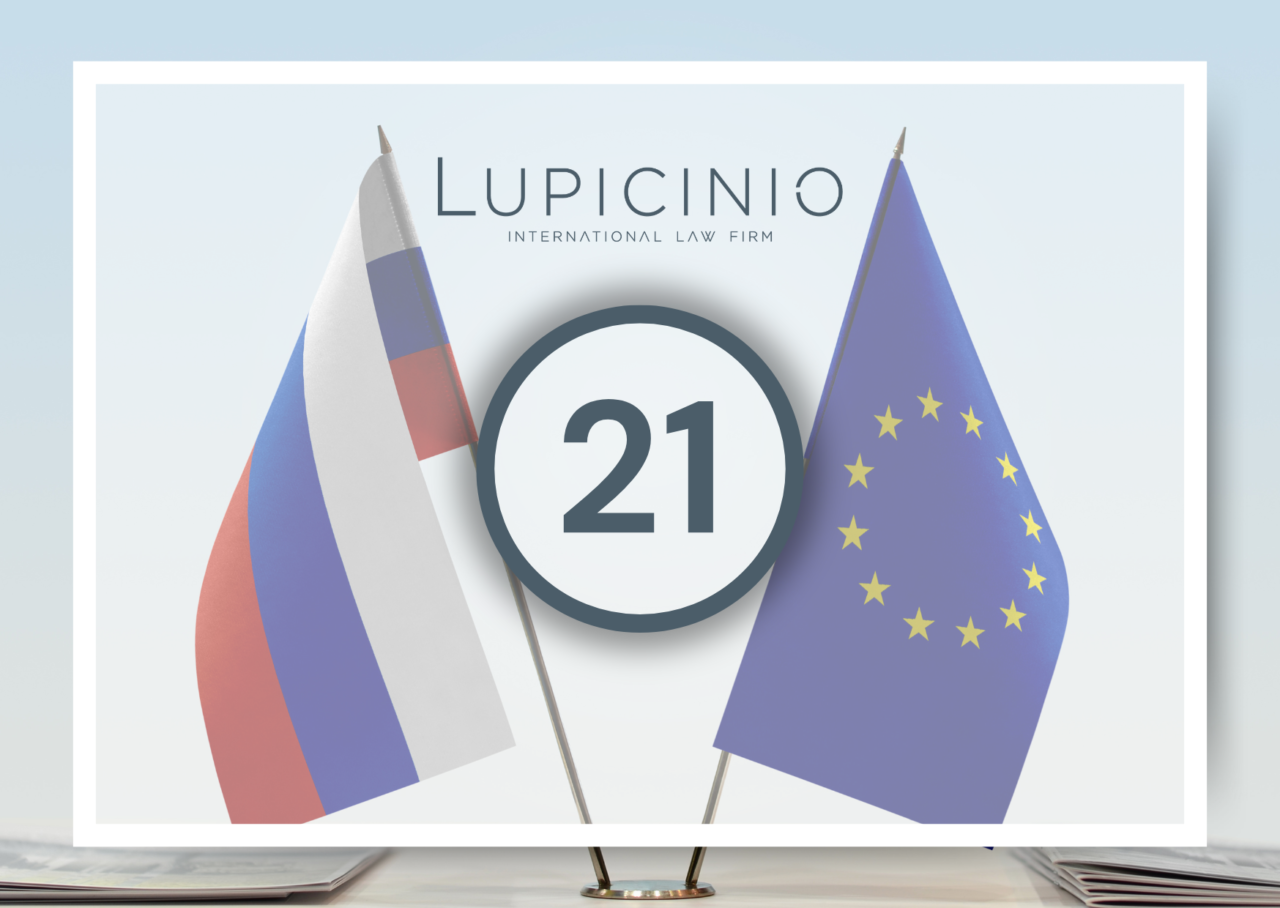
Nine legal acts were published in the Official Journal on 23 July, through which the EU has implemented its 21st package of sanctions against the Russian Federation. This is a package of measures of considerable scope and severity, which further tightens the European sanctions regime against that country. The following aspects of these legal provisions are particularly noteworthy:
- Council Implementing Regulation (EU) 2026/1843 implementing Regulation (EU) No 269/2014, Council Regulation (EU) 2026/1844 amending Regulation (EU) No 269/2014, and Council Decision (CFSP) 2026/1845 amending Decision 2014/145/CFSP, concerning the adoption of restrictive measures in response to actions that undermine or threaten the territorial integrity, sovereignty and independence of Ukraine.
The sanctions lists include 48 individuals (primarily businesspeople linked in various ways to the drone sector, but also journalists, intellectuals, artists, etc.) and 168 entities (numerous regional banks, totalling more than 90 banks and financial institutions, manufacturers of vehicles, aircraft engines, antennas for radio equipment, etc., some holding companies with a presence in many sectors, as well as mining and refining companies, etc.). All these entities are subject to sanctions involving the freezing of their assets, a ban on making assets available to them and, in the case of individuals, a ban on entering and travelling within the territory of EU Member States.
On the other hand, however, the circumstances in which the competent national authorities may authorise the use of frozen assets have been expanded. The most significant of these relates to payments due from those subject to sanctions or from an insurance provider as a result of a risk for which they are liable and which has materialised, provided that the payment is collected by an entity established in the EU, the EEA, Switzerland or a country listed in Annex VIII to Regulation (EU) No 833/2014. In addition, exemptions are introduced regarding payments to enable the continued operation of necessary rail transport between Russia and the EU via the EU and within Russia in relation to the Kaliningrad region, as well as in respect of certain investments related to the Paks II project.
The new regulations also extend protection against claims arising from any transaction whose execution has been affected, directly or indirectly, in whole or in part, by EU sanctions. Two new rules are thus established:
a) Natural persons who are nationals of an EU Member State and legal persons incorporated under the law of an EU Member State shall be entitled to compensation, in legal proceedings before the competent courts of a Member State, for all direct or indirect damages suffered by such persons or by legal persons owned or controlled by them, as a result of claims brought before the courts of third countries by sanctioned persons or by anyone acting on their behalf, or by natural and legal persons from third countries who make assets available to sanctioned persons, in relation to transactions that have been affected in any way by the sanctions. Compensation for damages would be sought from the aforementioned claimants.
b) No writ, order, interim measure, judgment or other judicial or administrative decision based on Russian law, or issued by a Russian court or authority, whether on the basis of a contract, the law of non-contractual liability or any other legal basis, which hold a national of a Member State or a legal person incorporated under the law of a Member State liable, or which give effect to any claim, right or obligation alleged against such persons, including in insolvency proceedings, in relation to any transaction the performance of which has been affected by the sanctions measures, shall be recognized, given effect to or enforced in a Member State.
- Council Regulation (EU) 2026/1848 amending Regulation (EU) No 833/2014 and Council Decision (CFSP) 2026/1849 amending Decision 2014/512/CFSP, concerning restrictive measures in response to Russia’s actions destabilising the situation in Ukraine.
These regulations have introduced significant changes, of which we highlight the following:
a) The exemptions have been amended to ensure the continued supply of the goods and services necessary to maintain Internet access in Russia for the general public.
b) A further 51 entities have been added to Annex IV of Regulation (EU) No 833/2014. These are companies linked to, or supporting in a wide variety of ways, the Russian military-industrial complex, or contributing to Russia’s technological advancement in the fields of defence and security. Among the newly listed entities are some from third countries (Hong Kong, Turkey, China, India, Kyrgyzstan, the United Arab Emirates and Kazakhstan).
c) The list of items and products that may contribute to Russia’s military and technological advancement and which therefore may not be exported to that country has been expanded (various forms of nickel, beryllium, aviation components used in drones, certain films, tapes and self-adhesive strips used in the defence sector, etc.).
d) The list of products that generate significant revenue for Russia and which, consequently, may not be imported is also extended (copper, nickel and lead ores, crude zinc, certain inorganic chemicals, resin oil, etc.).
e) With regard to sanctions on Russian oil, it should be noted, amongst other aspects, that the procedure for amending the oil price cap (calculation of the average price of Russian crude oil over a twenty-two-week period, the publication of that price and the corresponding regulatory amendment) is suspended from 24 July 2026 until 14 July 2027. Furthermore, under certain conditions, the competent national authorities are permitted to dispose of shipments of Russian oil that they seize or confiscate, meaning they may sell, transfer, manage or store it. It should also be noted that a Georgian refinery has been sanctioned.
f) With regard to Liquefied Natural Gas (LNG), a temporary exemption is introduced concerning the transfer of LNG originating in or exported from Russia when transferred to third countries; the temporary exemption shall apply only where the purchase relates to a specific transfer carried out by an EU operator. The possibility for Russia to use tankers for the transport of LNG is also restricted.
g) A total of 33 credit or financial institutions are added to the list of legal entities subject to the transaction ban.
h) The list of sanctioned vessels is expanded by the addition of 41 names.
i) The restrictions relating to crypto-assets are particularly stringent and significant; sanctions in this sector have been significantly tightened, especially with regard to activities involving third countries. Consequently, from 25 August 2026, Russian nationals or natural persons resident in Russia are prohibited from owning or controlling a legal person established or incorporated under the law of a Member State that provides any crypto-asset services, as defined in Regulation (EU) 2023/1114. It is also prohibited to participate, directly or indirectly, in any transaction with legal entities providing crypto-asset services or platforms facilitating the exchange or transfer of crypto-assets that are established in a third country listed in Annex LVII, which will include states that repeatedly and systematically contribute to the circumvention of European sanctions in this area.
j) Provisions are introduced, within the scope of Regulation (EU) No 833/2014, which are parallel to those described above regarding the right to receive compensation and the non-enforceability of Russian decisions within the EU.
k) The way is paved, pending the adoption of a Council Decision and other legal acts necessary for its implementation, for the establishment of a targeted ban on the issuance of short-stay visas to persons who have been on active duty in the Russian armed forces since 24 February 2022 and have been involved in the events that have taken place in Ukraine.
- Council Regulation (EU) 2026/1846 amending Regulation (EC) No 765/2006, Council Implementing Regulation (EU) 2026/1817 implementing Regulation (EC) No 765/2006, Council Implementing Decision (CFSP) 2026/1816 implementing Decision 2012/642/CFSP, and Council Decision (CFSP) 2026/1847, concerning the adoption of restrictive measures in view of the situation in Belarus and that country’s involvement in the Russian aggression against Ukraine.
The main new features of these regulations, which in many respects bear a striking resemblance to the sanctions imposed on Russia, are as follows:
a) Four entities have been added to the list of legal persons subject to restrictions regarding authorisations for the supply of dual-use goods and technologies, and of goods and technologies that may contribute to the military and technological advancement of Belarus or Russia or to the development of their defence and security sectors.
b) The list of items that may contribute to the military and technological advancement of Belarus, and which therefore may not be exported to that country (nickel, beryllium, etc.), has been expanded.
c) Exemptions are extended to ensure internet service in Belarus.
d) New restrictions are introduced on imports of products that enable Belarus to diversify its sources of revenue (copper ores, nickel, etc.).
e) The prohibition on Belarusians or persons resident in Belarus owning or controlling European legal persons in the crypto-asset sector is extended.
f) A provision is introduced, within the scope of the regulations under discussion, which is parallel to those previously described regarding the right to receive compensation.
g) The names of two legal persons are added to the list of entities subject to the freezing of assets and the prohibition on making assets available to them.
From all that has been set out so far, it is clear that we are dealing with a very extensive and extremely complex package of sanctions that requires careful analysis and a highly cautious and prudent approach on the part of legal practitioners.
With the collaboration of José Luis Iriarte, Professor of Private International Law at the Universidad Pública de Navarra.
******
More information:
Lupicinio International Law Firm
C/ Villanueva 29
28001 Madrid
P: +34 91 436 00 90