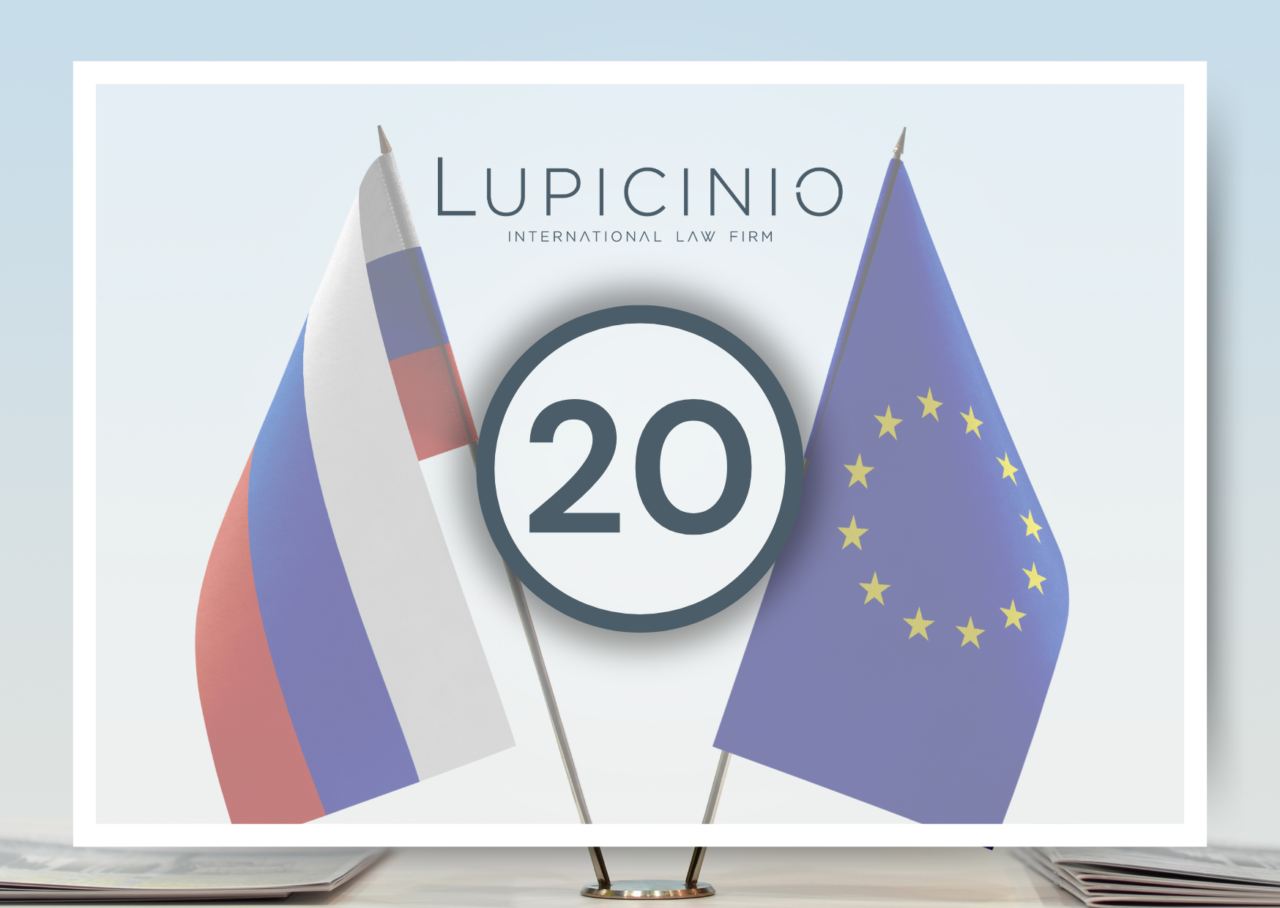
On 23 April 2026, the Council of the European Union adopted the twentieth package of sanctions against the Russian Federation, representing one of the most comprehensive sets of restrictive measures of the past two years and significantly impacting the energy, financial, commercial and military sectors.
Its adoption follows several months of deadlock, caused by the completion of repairs to the Druzhba pipeline as it crosses Ukrainian territory, which ultimately led Hungary and Slovakia to withdraw their opposition to the package.
Notably, on the same day, Member States also formally approved the €90 billion loan for Ukraine agreed in December 2025, which had likewise been stalled for the same reasons. The loan, guaranteed by the EU budget, will allocate approximately €60 billion to the war effort and €30 billion to the ordinary functioning of the Ukrainian state during the period 2026–2027. Half of these funds will be disbursed during this year.
Key developments:
List of sanctioned natural and legal persons
An additional 33 individuals and 83 entities have been added to the list, subject to asset freezes, a prohibition on making funds and economic resources available, and travel restrictions in the case of individuals.
Energy and shadow fleet
The package establishes the legal basis for a future total ban on maritime services linked to Russian oil and oil products, in coordination with the G7 and the Price Cap Coalition. However, the ban on providing services to icebreakers and LNG tankers flying the Russian flag or under Russian management entered into force on 25 April 2026, while the ban applicable to foreign-owned vessels operating in Russia will take effect on 1 January 2027.
In addition, 46 vessels have been added to the list of the Russian shadow fleet, bringing the total number of designated vessels to 632. A ban has also been introduced on the direct and indirect sale of oil tankers to Russian entities, together with the obligation to include in any sale contract a clause prohibiting resale to Russian entities or use for the benefit of Russia.
As regards sectoral listings, 36 entities from the Russian energy sector have been designated, covering both upstream (exploration and extraction) and downstream (refining and transport) segments. These include seven Russian refineries (Tuapse, Komsomolsk, Angarsk, Achinsk, Ryazan, Afipsky and the Lukoil plant in Usinsk) and the two major oil producers Bashneft and Slavneft.
The package also prohibits transactions with the ports of Murmansk and Tuapse, as well as with the oil terminal at the port of Karimun in Indonesia, which is used to circumvent the price cap mechanism.
A notable development is the introduction of mandatory due diligence requirements for the sale of oil tankers, along with a ban on the provision of maintenance services to Russian-owned icebreakers and LNG tankers.
Financial services and crypto-assets
The EU has imposed a transaction ban on 20 Russian banks, as well as on four financial institutions from third countries believed to have circumvented EU sanctions or to be connected to the Russian Financial Message Transfer System (SPFS), the Russian equivalent of SWIFT.
In light of Russia’s increasing reliance on cryptocurrencies for international transactions as a result of sanctions on its financial sector, the EU has designated a Kyrgyz entity operating a platform on which the state-backed stablecoin A7A5 is traded.
The package also introduces a total sectoral ban on providers and platforms based in Russia that facilitate the transfer and exchange of crypto-assets, prohibiting transactions in the RUBx cryptocurrency and any EU support for the development of the digital rouble. To prevent circumvention, netting operations with Russian counterparties are now prohibited.
Military-industrial complex and third countries
Sixty entities have been added to the list of those providing direct or indirect support to the Russian military-industrial complex or involved in sanctions evasion; 32 are based in Russia and 28 in third countries, including China (including Hong Kong), Turkey, the United Arab Emirates and Thailand.
Foreign trade and anti-circumvention tool
For the first time, the EU has activated its anti-circumvention instrument, banning the export of computer numerical control (CNC) machines and radio communication equipment to Kyrgyzstan due to the significant risk of re-export to Russia for use in the manufacture of drones and missiles. This measure responds to the marked and systematic increase in re-exports of high-priority items via that country.
The export restriction regime has also been extended to cover laboratory equipment, high-performance lubricants, certain energy-related materials, chemicals, vulcanised rubber products and tools for metal production, with a total value exceeding €360 million. In parallel, new restrictions have been introduced on the import of raw materials, metals and minerals, scrap metal and certain chemical products, amounting to more than €570 million.
Additional designations relating to fundamental rights and broadcasting
The twentieth package includes the designation of five individuals and one entity for their alleged involvement in the abduction, forced transfer and indoctrination of Ukrainian minors. In addition, four individuals linked to the appropriation of Ukrainian cultural heritage and four individuals associated with alleged propaganda activities, some connected to state-funded platforms, have been designated.
In the media sector, the broadcasting ban has been extended to websites disseminating content identical to that of previously banned entities, in line with the Charter of Fundamental Rights of the European Union.
Legal protection for European companies and cybersecurity
The package introduces strengthened legal safeguards to protect EU companies against potential arbitrary expropriation and court rulings issued in Russia in connection with the sanctions. It also establishes an explicit ban on the provision of cybersecurity services to Russia.
Belarus
As regards Belarus, the sanctions regime has been extended until 28 February 2027. The package includes three new designations linked to the Belarusian military-industrial complex and the government. For the first time, a Chinese state-owned entity has been listed under the Belarus sanctions regime due to its role in the production of military equipment.
Legal framework
-
- Council Decision (CFSP) 2026/504 of 23 April 2026 amending Decision 2014/145/CFSP concerning restrictive measures in respect of actions undermining or threatening the territorial integrity, sovereignty and independence of Ukraine
- Council Implementing Regulation (EU) 2026/509 of 23 April 2026 implementing Regulation (EU) No 269/2014 concerning restrictive measures in respect of actions undermining or threatening the territorial integrity, sovereignty and independence of Ukraine
- Council Regulation (EU) 2026/511 of 23 April 2026 amending Regulation (EU) No 269/2014 concerning restrictive measures in respect of actions undermining or threatening the territorial integrity, sovereignty and independence of Ukraine
- Council Decision (CFSP) 2026/508 of 23 April 2026 amending Decision 2014/512/CFSP concerning restrictive measures in view of Russia’s actions destabilising the situation in Ukraine
- Council Regulation (EU) 2026/506 of 23 April 2026 amending Council Regulation (EU) No 833/2014 concerning restrictive measures in view of Russia’s actions destabilising the situation in Ukraine
- Council Decision (CFSP) 2026/512 of 23 April 2026 amending Decision 2012/642/CFSP concerning restrictive measures in view of the situation in Belarus and the involvement of Belarus in the Russian aggression against Ukraine
- Council Regulation (EU) 2026/513 of 23 April 2026 amending Regulation (EC) No 765/2006 concerning restrictive measures in view of the situation in Belarus and the involvement of Belarus in the Russian aggression against Ukraine
- Council Implementing Decision (CFSP) 2026/503 of 23 April 2026 implementing Decision 2012/642/CFSP concerning restrictive measures in view of the situation in Belarus and the involvement of Belarus in the Russian aggression against Ukraine
- Council Implementing Regulation (EU) 2026/505 of 23 April 2026, implementing Article 8a(1) of Regulation (EC) No 765/2006 concerning restrictive measures in view of the situation in Belarus and the involvement of Belarus in the Russian aggression against Ukraine
With the collaboration of José Luis Iriarte, Professor of Private International Law at the Universidad Pública de Navarra.
******
More information:
Lupicinio International Law Firm
C/ Villanueva 29
28001 Madrid
P: +34 91 436 00 90