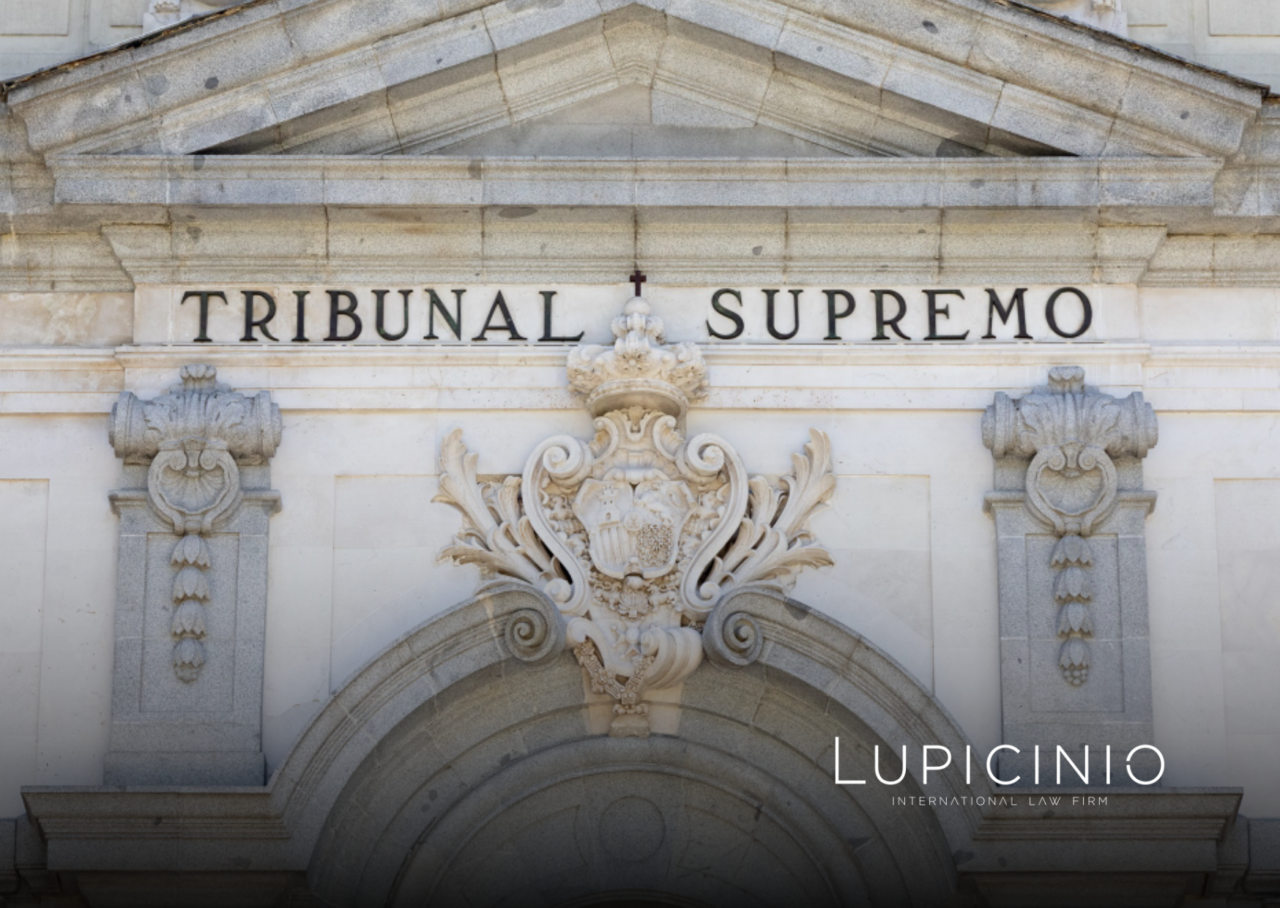
In today’s fast-paced business environment, visits from the Labour and Social Security Inspectorate (ITSS) are a reality that every company must be aware of and know how to manage. Recently, a Supreme Court ruling has sparked significant controversy by reinterpreting the limits of these inspections, placing a fundamental right— the inviolability of the home— at the heart of the debate.
Given the significance of this ruling and the reactions it has provoked, we have prepared a brief, detailed analysis to provide you with the necessary information.
Table of Contents
- The origin of the controversy: What exactly happened?
- The ruling of the Supreme Court: A technical overview of the Judgment
- The reaction: The critical stance of Labour Inspectors
- Analysis of the controversy: Protection of Rights or Limitation on Effectiveness?
- Legal uncertainty for businesses: a dilemma on the horizon
The origin of the controversy: What exactly happened?
To comprehend the scope of the ruling, it is essential to know the facts that led to it. The case dates back to 23 October 2024, when the Labour Inspectorate, with the assistance of the National Police, entered the premises of a company.
The key points of this operation, according to Supreme Court Ruling 441/2026 of 14 April, were:
- Entry without judicial authorisation or consent: The inspection took place without the officials carrying a judicial authorisation and without the company owner giving their permission.
- Coincidence of registered office and place of work: The inspected premises (an industrial unit) were not only a place of work, but they also constituted the registered office of the company.
- Absence of search: During the visit, the inspectors did not search any physical or digital files nor did they seize any company documentation.
- Purpose of the inspection: Curiously, the inspection was not aimed to the appellant company, instead it sought to verify data relating to employees of another company.
The company concerned considered that the mere entry without permission violated its fundamental right to the inviolability of the home (Article 18.2 of the Spanish Constitution) and lodged an appeal. After being dismissed at first instance, the case reached the Supreme Court, which had to resolve a matter of great interest: is it constitutionally valid for the Labour Inspectorate to enter a company’s registered office without judicial authorisation, even if no search is carried out?
The ruling of the Supreme Court: A technical overview of the Judgment
The Contentious-Administrative Chamber of the Supreme Court, in its judgment, ruled in favour of the company and stablished a clear and unequivocal legal principle. Its reasoning is structured around several key points, which we specify below.
A.- Companies’ Registered Offices are also protected
The Supreme Court begins by recalling a fundamental premise: the right to the inviolability of the home is not exclusive to natural persons. Legal persons (companies, corporations, etc.) are also holders of this right.
Although the protection is ‘modulated’ — given that a company does not have the ‘personal and familiar privacy’ of a human being — it does cover the physical spaces where business is conducted and where its records and documents are kept, shielding them from the sight of third parties.
B.- The Law is insufficient and the Constitution prevails
The Gordian knot of the matter lay in Act 23/2015 of 21 July, on the Regulation of the Labour and Social Security Inspection System, in Article 13, which defines the powers of Labour and Social Security inspectors in the performance of their duties. This article authorises the inspectors to ‘enter freely at any time and without prior notice into any workplace’, but only requires consent or judicial authorisation ‘if the premises subject to inspection coincide with the domicile of a natural person’.
Thus, the law is remains silent on the premises of legal persons. The Supreme Court describes this omission as a ‘shortcoming’ in the legislation. However, it argues that this silence does not grant the Inspectorate carte blanche. The requirement for judicial authorisation need not be enshrined on the law, as it derives directly from the Article 18.2 of the Spanish Constitution. In a far-reaching legal manoeuvre, the Court does not set the law aside (which will oblige it to rise a question of unconstitutionality), but rather ‘fills that legal void’ by directly applying the Constitution.
C.- ‘Entry Or Search’: The key lies in the dichotomy
One of the strongest arguments in the judgment is based on a literal analysis of the Spanish Constitution. Article 18.2 prohibits ‘any entry or search’ without the necessary safeguards. The Court underlines that the use of the disjunctive conjunction ‘or’ is decisive.
This means that constitutional protection is triggered by the mere act of entry, without the need for a subsequent search to take place. Inviolability is breached from the moment the threshold is crossed without permission. To make protection dependent on what happens after entry would be, according to the appellant and with the Court’s agreement, ‘absurd’.
D.- You cannot put ‘The car before the horse’
The Court strongly criticises the logic put forward by the Administration, according to which inspectors could freely enter and would only need judicial authorisation if, once inside, they decided to examine documents.
Using a very vivid metaphor, the judgment states that this is ‘putting the cart before the horse’. The judicial authorisation must be obtained prior to any action within a protected space such as a domicile. It is not a permit that is requested halfway through the action, but rather the essential requirement for being able to commence it.
E.- The Exception that Proves the Rule: What if there are Separate Areas?
The Supreme Court opens the door to a single, very specific exception. Judicial authorisation may not be necessary if two conditions are met simultaneously:
- That there is a noticeable physical separation between the office area (registered office) and the production area (workplace).
- That the Inspectorate states, before entering, that its sole purpose is to access the workplace area.
Given that these conditions were not met in the case of the appellant company, the exception did not apply.
Court’s Conclusion: Mere entry, without a search, into a space that is both a registered office and a workplace requires prior judicial authorisation.
The reaction: The critical stance of Labour Inspectors
As expected, the ruling has provoked a strong reaction from inspector groups, who see it as an obstacle to the effectiveness of their work. Both the Labour and Social Security Inspection Union (SITSS) and the Progressive Union of Labour Inspectors (UPIT) have issued highly critical statements.
A.- Arguments of the Labour Inspection Union (SITSS)
In its statement, the SITSS, whilst respecting the court’s decision, expresses its ‘concern’ regarding the practical consequences of the ruling:
- Difficulty in carrying out ‘surprise’ inspections: The need to seek judicial authorisation removes the element of surprise, which is key to detecting flagrant irregularities (excessive working hours, irregular employment, etc.).
- Undue equivalence: They consider that the ruling equates the protection of companies’ premises almost entirely with that of natural persons, whereas constitutional case law has always held that the protection afforded to legal persons is ‘lesser’ and relates to documentation, not privacy.
- The law was clear: They argue that Article 13 of Act 23/2015 of 21 July, on the Regulation of the Labour and Social Security Inspection System, deliberately distinguished between natural and legal persons, and that the Court has gone beyond the legislator’s intention.
- Impact on the business sector: They warn that, in Spain, where there are many SMEs in which the registered office and place of work are the same, this requirement ‘would seriously compromise the immediacy and effectiveness of inspection activities’.
B.- Arguments of the Progressive Union of Inspectors (UPIT)
The UPIT’s statement is even more blunt and directly accuses the Supreme Court of ‘legislating’:
- Invasion of powers: They argue that the Court is not interpreting a doubtful provision, but rather ‘broadening a provision without justifying why the legislator’s intent is being called into question’.
- Question of unconstitutionality: They maintain that if the Court considered the law might be unconstitutional by omission, its duty was to raise a question of unconstitutionality before the Constitutional Court, not to ‘become a sort of legislator’.
- Restrictive interpretation of the judgment: The UPIT proposes a very limited reading of the ruling. They assert that protection extends only to the “physical spaces essential for the functioning of the company’s management centre”. Therefore, they announce their intention to continue carrying out visits without judicial authorisation to workplaces that coincide with registered offices, limiting their actions to areas that are not strictly management areas and notifying the company of this.
Analysis of the controversy: Protection of Rights or Limitation on Effectiveness?
We are faced with a classic conflict between the effectiveness of the State’s inspecting powers and the protection of the fundamental rights of the individual.
- The Supreme Court’s Perspective: The judiciary acts as the ultimate guarantor of the rights enshrined in the Constitution. From this perspective, if a law does not explicitly include a guarantee that stems directly from the Constitution (such as the need for judicial authorisation to enter a domicile), it is the duty of the courts to ‘fill’ that gap to ensure the maximum protection of the fundamental right. Legal certainty and the primacy of the Constitution take precedence over administrative efficiency.
- The Inspectors’ perspective: The inspection function is essential to guarantee workers’ rights and the proper functioning of the Social Security System. They argue that the bureaucracy and time required to obtain judicial authorisation negate the ability to act immediately and by surprise, allowing many infringements to go unpunished. They consider that the Court has created a disproportionate obstacle, upsetting a balance that the legislature had deliberately established.
The UPIT’s stance, announcing that they will continue to enter ‘workplace’ areas, foreshadows future litigation. It will be crucial to see how the lower courts interpret the exception noted by the Supreme Court regarding ‘appreciable physical separation’ and whether the inspector’s mere declaration that they will only visit a specific area is sufficient to circumvent the need for judicial authorisation.
Legal uncertainty for businesses: a dilemma on the horizon
The clash between the doctrine established by the Supreme Court in Ruling 441/2026 of 14 April and the reaction of the Labour Inspectorate’s trade unions plunges businesses, and particularly SMEs, into a situation of significant legal uncertainty. A complex dilemma arises: should they follow the criteria of the highest court or the interpretation of the officials who turn up at their premises? This uncertainty places the employer in a vulnerable position, forced to make far-reaching legal decisions in real time and, in many cases, without the necessary immediate advice.
For a small or medium-sized enterprise, where the registered office and the workplace are generally a single physical space without clear divisions, the situation is particularly delicate. The warning from the Progressive Union of Labour Inspectors (UPIT) that they will continue to carry out visits without judicial authorisation, limiting themselves to ‘areas defined as the workplace’, introduces a highly dangerous element of subjectivity. Who determines on the spot whether an office or a warehouse is a ‘management centre’ or a ‘work area’? This ambiguity leaves the door open to disputes right at the company’s entrance, where the person in charge must decide whether to allow entry, risking consenting to an action that could be null and void, or to refuse entry, facing a possible report for obstructing the inspection work.
This tension forces companies to adopt a proactive role that was not previously so imperative. The ruling, which in principle reinforces a constitutional guarantee, in practice shifts the burden of actively defending it onto the employer. Companies are forced to prepare for a potential legal dispute every time the Inspectorate comes knocking, with the costs and uncertainty that this entails, blurring the line between the cooperation owed to the authority and the legitimate defence of their fundamental rights.
In short, this ruling strengthens companies’ safeguards against inspection proceedings, but requires a greater understanding of their rights and adequate preparation to manage these situations with legal certainty.
******
More information:
Lupicinio International Law Firm
C/ Villanueva 29
28001 Madrid
T: +34 91 436 00 90